
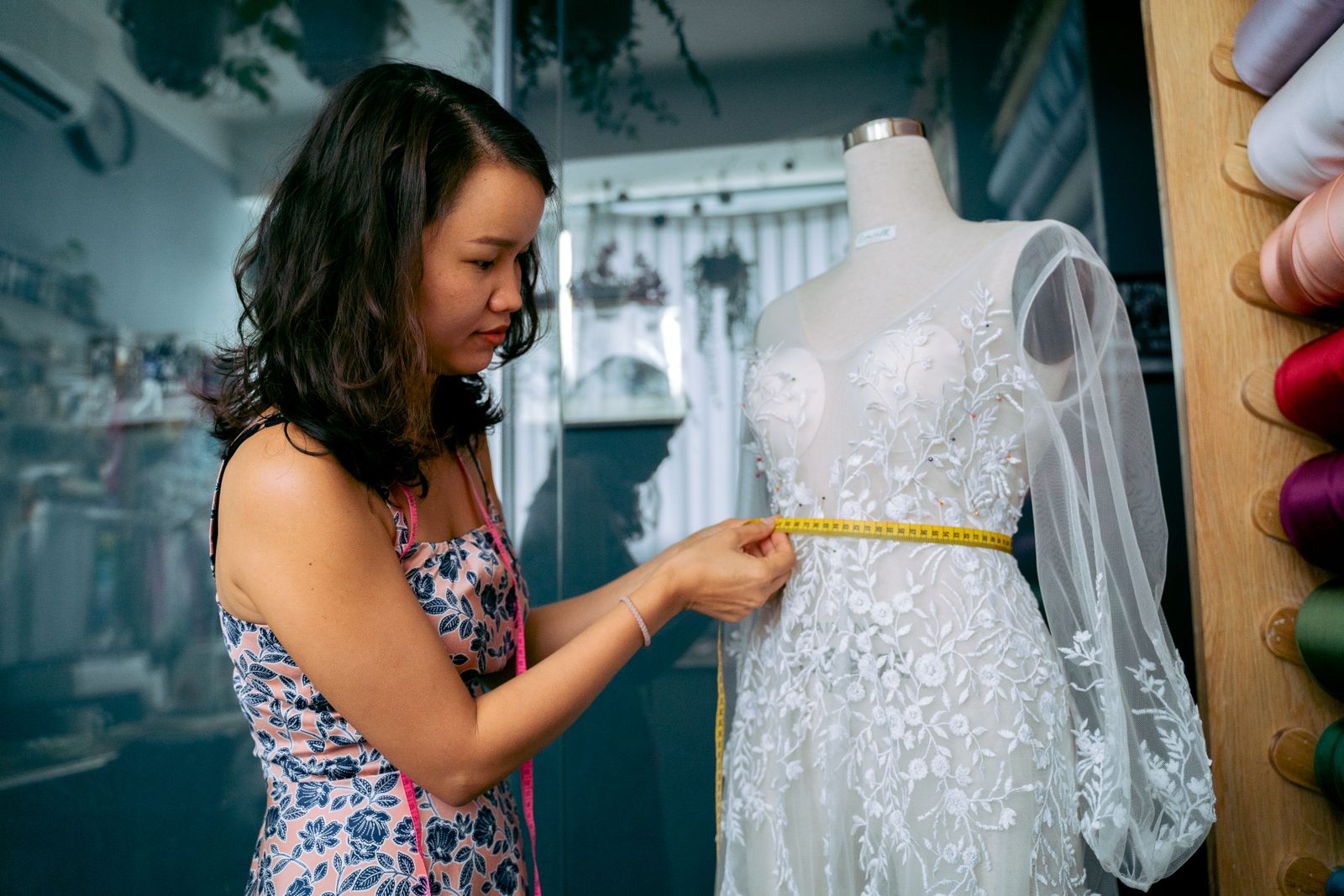
A corset-style dress may use visible corset lines without functioning like a separate historical corset. The buyer therefore needs to specify the intended result: decorative paneling, light shaping, bust support, a close strapless fit, or a more structured internal bodice. That decision changes the pattern, materials, closure and sample checks.
What forms the corset dress construction system?
The outer shell is only one part. A structured bodice can combine a shell fabric, stable underlayer, lining, cups or shaped panels, boning or other reinforcement, seam allowances or channels, neckline support, waist stay, closure and the join to the skirt. Each element should have a defined job instead of being added because it appears in a reference image.
Boning can help resist vertical collapse and keep panel lines extended, but it does not automatically create correct fit or bust support. Cups, seam shaping, stable fabric, elastic, underwire or internal tapes may carry different loads. The brief should name which result is required, while the pattern and sample determine how the parts work together.
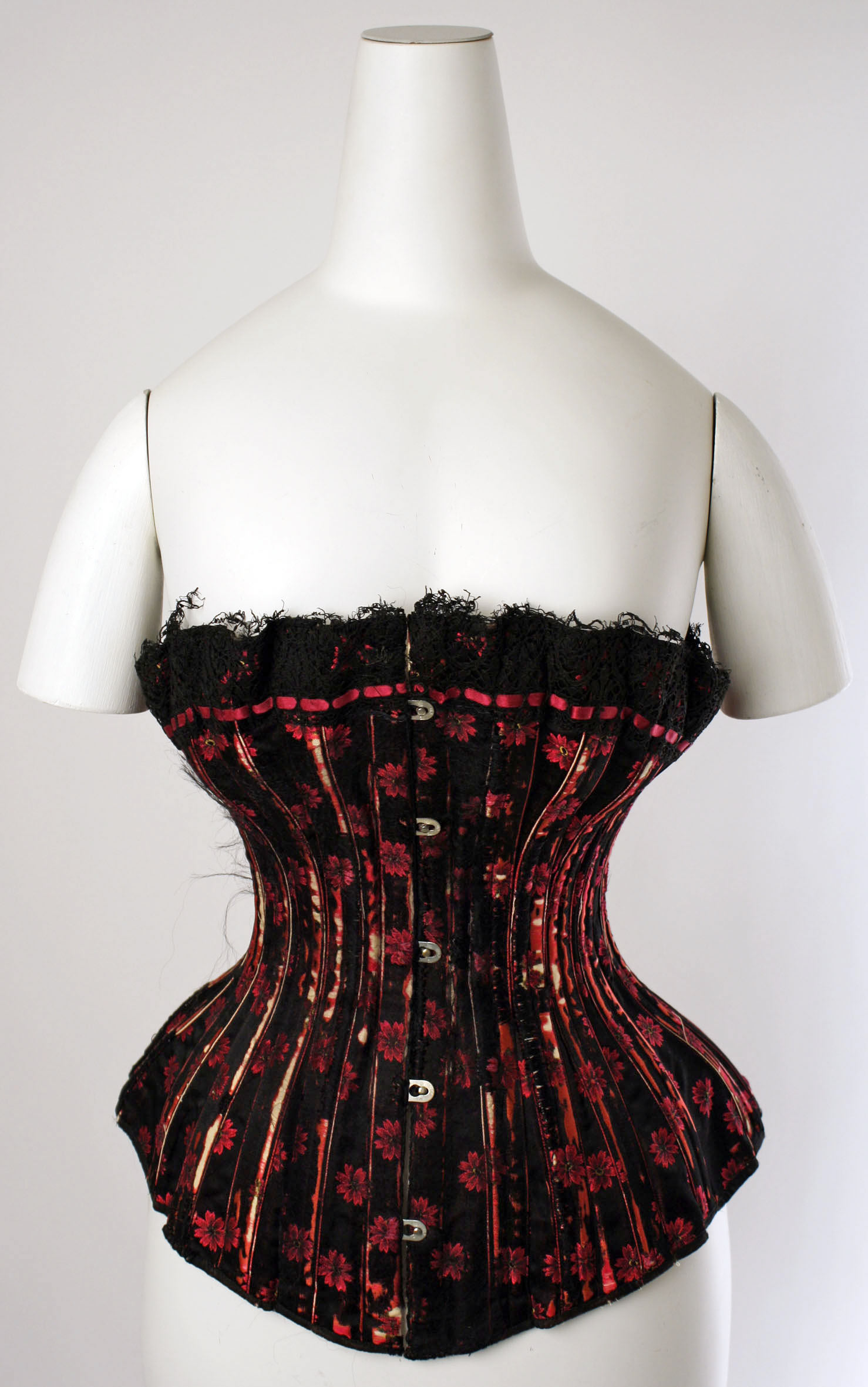
A historical corset makes this systems idea visible. The Metropolitan Museum of Art records the object below as an 1880s British corset made from silk, cotton and stays. It is included as a construction reference, not as a template for a modern dress.
Why must pattern and fit be approved before support details?
Internal support cannot repair a pattern that is the wrong shape or length. For structured bodice manufacturing, first define the body measurements, wearing ease, neckline position, bust point, waist level, centre-front and centre-back lengths, and where the bodice ends or joins the skirt. The fit review should also identify whether the dress is worn with a separate bra, built-in cups or no additional support.
A China National Garment Association patternmaking article dated 7 March 2025 develops several dress shapes from a basic fitted bodice and tells pattern makers to check matching side-seam lengths and smooth joins at the neckline, armhole and hem. It is a patternmaking lesson rather than a corset production standard, but it reinforces the buyer's practical need to approve connected pattern lines rather than isolated measurements.
ISO 18890:2018, confirmed in 2024, defines main garment measurement points and a standard method for garment dimensions; it also allows interested parties to agree additional points. A structured bodice normally needs style-specific points written into the tech pack and measured consistently on the approved sample.
What should the internal support map record?
Use an inside-view sketch or marked sample to identify every support component. Show the boning or reinforcement position, material, end treatment and channel; cup or underwire reference where used; waist support; seam allowances; neckline stabilisation; closure reinforcement; lining attachment; and the point where skirt weight enters the bodice.
| Approval area | What to record | What the sample should show |
|---|---|---|
| Fit reference | Body or mannequin, size, measurements and intended ease | Stable neckline, balanced waist and repeatable placement |
| Layer system | Shell, strength layer, lining, cups and interfacing | No unwanted show-through, bubbling or edge bulk |
| Support map | Boning or reinforcement type, position, channel and ends | Controlled shape without sharp pressure or exposed ends |
| Closure | Zip, hooks, lacing or other route and its reinforcement | Secure operation without distortion or skin contact risk |
| Bodice-to-skirt join | Waist seam, hanging method and weight distribution | Skirt weight does not pull the neckline or rotate the bodice |
| Inside finish | Lining, binding, labels and access for alteration or repair | Clean coverage of support parts and comfortable wear |
Do not approve “boning” as a single line item without its material and end treatment. A channel that is too wide can allow movement; a poorly finished end can create a hard point; and a support piece placed across a flexible or curved area can change comfort and appearance. The correct choice is style- and material-specific.
What should corset sample approval cover?
Start with static fit, then check movement. Review the front, side and back while the wearer stands naturally, raises the arms, sits and takes a full breath. Record gaping, neckline roll, cup or bust position, waist migration, closure strain, skirt pull, local pressure and whether any reinforcement becomes visible through the shell.
Inspect the inside as a production reference. Compare left and right support placement, channel width, seam allowance treatment, lining coverage, closure reinforcement and attachment at the waist. If the trial changes, issue a revised pattern, bill of materials and inside-construction record together; an outside photograph alone cannot control hidden work.
The approved sample should be named and dated. Close the fit comments, material references, support map, measurement chart, workmanship points and open questions before it becomes the pre-production reference. If the shell fabric, lining, cup, reinforcement or closure changes later, identify which approval must be repeated.
Which technical evidence can support the approval?
Testing should follow the actual failure risk. ISO 13935-2:2026 specifies a grab method for determining the maximum force to seam rupture, including considerations for sampling structural seams from garments. Its public scope says the method applies to straight seams and is mainly for woven fabrics; it does not provide one universal pass value for every corset dress or cover curved seams automatically.
A project may also need seam-slippage, closure, attachment, colour, dimensional-change or care evidence, depending on the fabrics and target market. The method, specimen, conditioning and acceptance criteria should be agreed before testing. A laboratory result for one straight seam does not replace wearer fit, movement review or inspection of support placement.
For US sales, the Federal Trade Commission Care Labeling Rule guidance requires a reasonable basis for care instructions and says the evidence must account for the complete garment and its non-detachable components. Shell, lining, cups, reinforcement, closure and decoration therefore need a compatible care route.
How does PIPK review a structured bodice brief?
As of 23 September 2026, PIPK's published development scope asks buyers to specify lining, facing, interfacing, support and closures during sampling. Its custom womenswear development page specifically includes discussion of boning, cups and support layers for structured bodices, with the sample reviewed inside as well as outside.
PIPK can review a reference, sketch or tech pack, propose a project-specific development route and connect the approved construction to sample comments and production checks. Exact materials, support method, test scope, quantity, price and timing depend on the style and current supplier route; they require written confirmation for the project.
Brief for construction review
What should the buyer send?
A complete brief helps a corset dress manufacturer distinguish the intended look from the support and fit the garment must deliver.
- Front, side, back and inside references, plus a sketch or current tech pack
- Target customer, base size, body measurements and size range
- Intended support result: decorative, light shaping, bust support or close strapless fit
- Shell, strength layer, lining, cup, reinforcement and closure requirements
- Neckline, waist, bust point, bodice length and movement priorities
- Skirt weight, attachment route, embellishment and any removable components
- Target market, proposed care route and required tests or acceptance criteria
- Named approver, fitting comments and evidence needed before bulk release
Use the garment sample approval guide to separate proto, fit and pre-production decisions. For decorated bodices, connect the inside construction to the embellishment quality-control record; for quantity planning, review the complex-style MOQ guide.
Reliable corset dress construction approval links the fitted pattern, internal support map, materials, closure, movement review and inside workmanship to one dated sample. Send PIPK the style reference, measurements, support intent, materials and approval requirements for a project-specific development review.
Further reading
Sources
These sources support the pattern, measurement, seam-test and care boundaries above. They do not set one universal construction method, comfort limit, test value or PIPK commercial term.
China National Garment Association: five summer-dress pattern variations, 7 March 2025 International Organization for Standardization: ISO 18890:2018, garment measurement International Organization for Standardization: ISO 13935-2:2026, seam maximum force by grab method US Federal Trade Commission: Care Labeling Rule guidance